


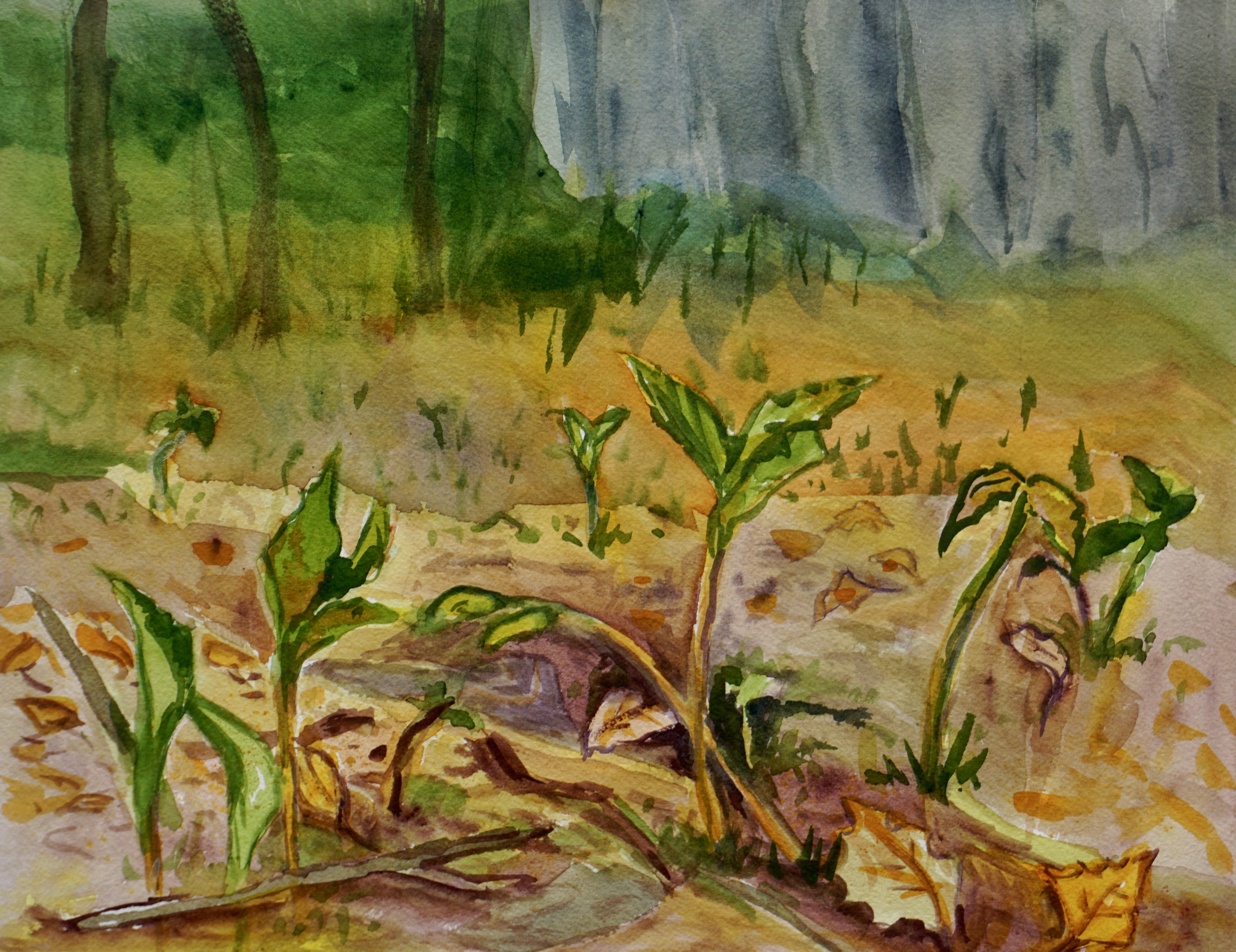

This spring brought a carpet of maple seedlings to my yard. Every square foot of the back, sides, and front of the house developed a 5 o’clock shadow of green stems with twinned leaves poking up from the soil and leaf litter. And so over the past couple of weeks I’ve been plucking hundreds of dainty roots out and tossing them in a compost bag. I enlisted my 7-year-old daughter Juniper to help. She quickly learned to recognize maples and has become so efficient at removing them that she’s started yanking them from neighbors’ yards when we walk to school.
Weeding my yard to remove whatever plant has taken over has become a grim spring ritual. I know that if I don’t work quickly, I’ll end up with back-breaking clearing later in the season. Often it’s maples, but sometimes it’s swallow-wort or hawkweed or some other fast-spreading plant with a medieval name.
When we first moved into a house, I was excited to own my own little plot of land for the first time. I imagined how rewarding it would be to care for the landscaping and nurture a garden. But I grew up in the desert Southwest and had little experience with Northeast gardening. I was totally unprepared for the sheer carnage necessary to maintain a yard in this climate. After the first year watching the yard get overrun by weeds as tall as myself, I realized that my real role was not to nurture anything, but to serve as executioner for hundreds of plants that constantly sprouted from the yard’s fertile soil throughout the growing season. My days are spent digging, pulling, chopping, and filling yard waste bags.
I keep this up because I love my yard and want to take care of it, and I feel a social pressure to keep it relatively managed. But I also recognize the beauty and value of the plants that I so unceremoniously rip out, particularly these maples. I see irony of being someone who cares about urban trees, who has lectured students about the importance of urban forests and tree canopies, to be working so diligently to fight land that clearly wants to become a forest. I realized this essential fact about my yard a few years ago when the maples were especially productive. And then it dawned on me that all the meadows and other open spaces I see in New England are generally mowed or weeded by someone. Otherwise: forest.
Part of me wishes, romantically, to just let my yard go wild. Why not? Why is it so culturally verboten to let things grow in yards that actually choose to do so? It is equally loathed by people who favor traditionally neat, cultivated landscaping and environmental types who feel that cities will fall prey to hordes of invasives if left to their own devices. It’s telling how we don’t generally use terms like “natural” or “wild” to describe vegetation that grows on its own in urban areas. These plants are usually called weeds or (more generously) volunteers. But the neutral term preferred by scientists is “spontaneous vegetation.”
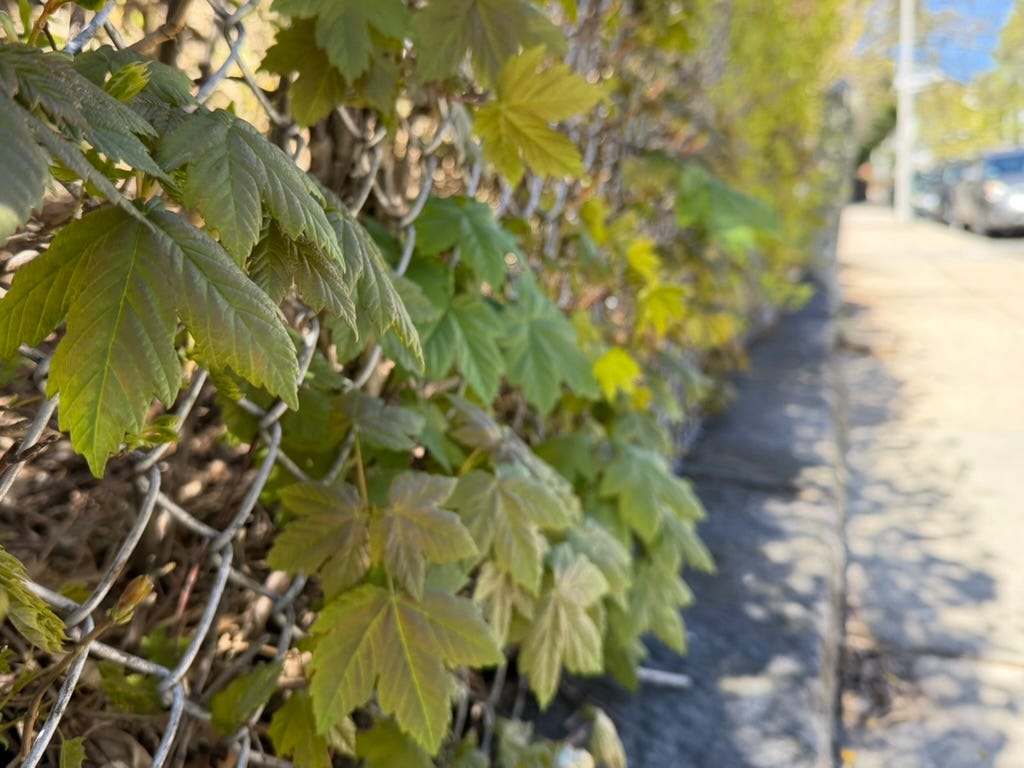
You see spontaneous vegetation in vacant lots and unkempt neighborhoods, and it’s often found on roadsides and small patches of interstitial land around highway on-ramps, rail lines, and steep hillsides. One of the best habitats for maples and other trees is around chain-link fences, where they can grow hidden among other landscaped plants until their roots are deep and strong, and they become a pain to remove. Urban areas are filled with fence forests nurtured by human inertia. In fact, when you look for it, you’ll see spontaneous vegetation everywhere, filling places you had never noticed.

My perspective on spontaneous vegetation has been shaped by Peter del Tredici, a prominent botanist and urban ecologist I wrote about back in 2010 and whose urban ecology course at Harvard I took while on a Knight Science Journalism fellowship at MIT. He introduced me to the idea that nothing is exactly native in a city, since cities are in many ways novel ecosystems. Urban areas have all the qualities I’ve described previously: patchy habitats, uneven management, and frequent disturbance, plus they tend to be warmer and prone to flash flooding, and they have different soil qualities and many constraints on plant growth. Expecting urban land to support only “native” vegetation is like building a swamp in the desert and then constantly ripping out the reeds that emerge to plant cacti.
Peter calls the species that do well in cities “cosmopolitan,” and they often hail from different places, some local and others not. His field guide, Wild Urban Plants of the Northeast, treats each plant that grows spontaneously in our urban environment with equal respect, whether it’s considered a “good” plant or a weed. If you live in this region, you’ll recognize many familiar plants in the book that are part of your everyday background but you never thought twice about. Some of these plants do aggressively take over less-managed land, and can rightfully be thought of as invasive. But in his own piece for the Boston Globe, he advocates for thinking beyond the native/invasive dichotomy and granting “amnesty” to certain introduced species that have long grown spontaneously in North America, “acknowledging that globalization, urbanization and climate change have permanently reshuffled the world’s ecology.”
The idea that cities should (at least sometimes, in some places) let vegetation run wild is slowly—very slowly—gaining ground. Yes, sometimes one aggressive plant takes over. But research has found that urban spontaneous vegetation in vacant lots can foster more biodiversity than nearby managed landscapes and support rare and endangered species of plants and birds. Letting vegetation organize itself could be a cost-effective way to support ecosystem services like biodiversity, carbon sequestration, and flood control without intense management. Allowing plants to naturally take over disturbed or reclaimed land and polluted brownfields can help nurture ecosystems in areas that resist native restoration.
Given that spontaneous vegetation requires little from us in the way of money or labor, it’s strange that it is not often seen as a critical part of urban sustainability. Why do people profess to love nature so much, but don’t allow nature to chart its own course in urban green spaces?
Well…mostly because people don’t like it. Spontaneous vegetation can look weedy and uncontrolled, and it requires accepting tradeoffs when species we don’t love flourish. I also believe it comes down to the fundamental issue I described when launching this newsletter: the human-nature dichotomy. We mentally divide humans from the natural world. Therefore, nature that actually chooses to live with people is not really Nature.
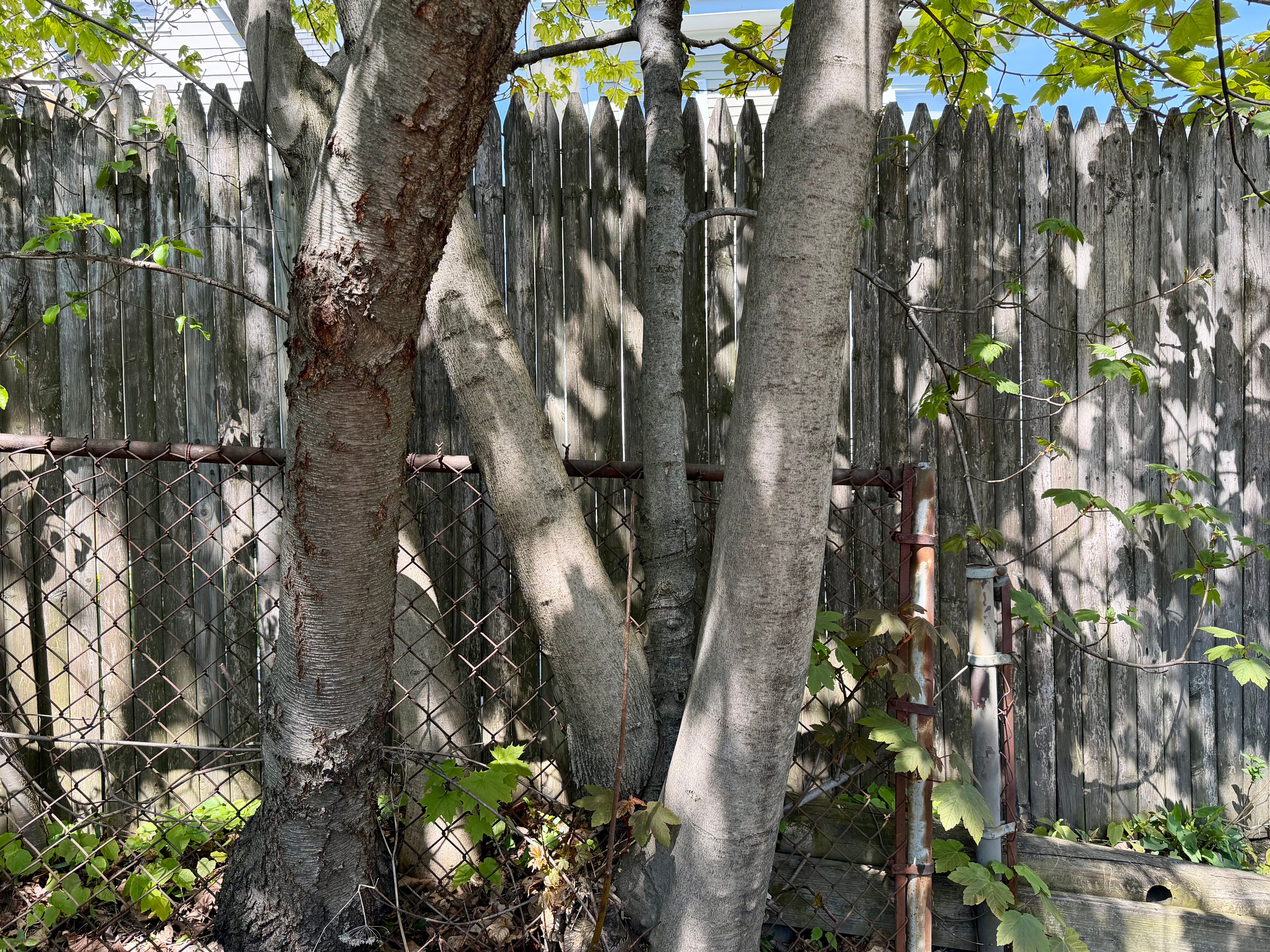

When my back patio lacked shade a few years ago, I deliberately left a group of spontaneous saplings growing along a remnant chain link fence, knowing that they would flourish more quickly and robustly than anything I might plant. A few years later, our fence forest keeps the patio shaded most of the day. And I prefer the odd angles the trees have found around each other to the lonely symmetry of a planted shade tree.
Can I offer the same fate to the maple seedlings coming up this year? Probably not. But I do check myself when I’m weeding in my yard. I overlook some interlopers, give them the benefit of the doubt, and experiment with watching them grow over the season in some corners of the yard. They’re not always what I wanted, but they add something else: a little spontaneity.