


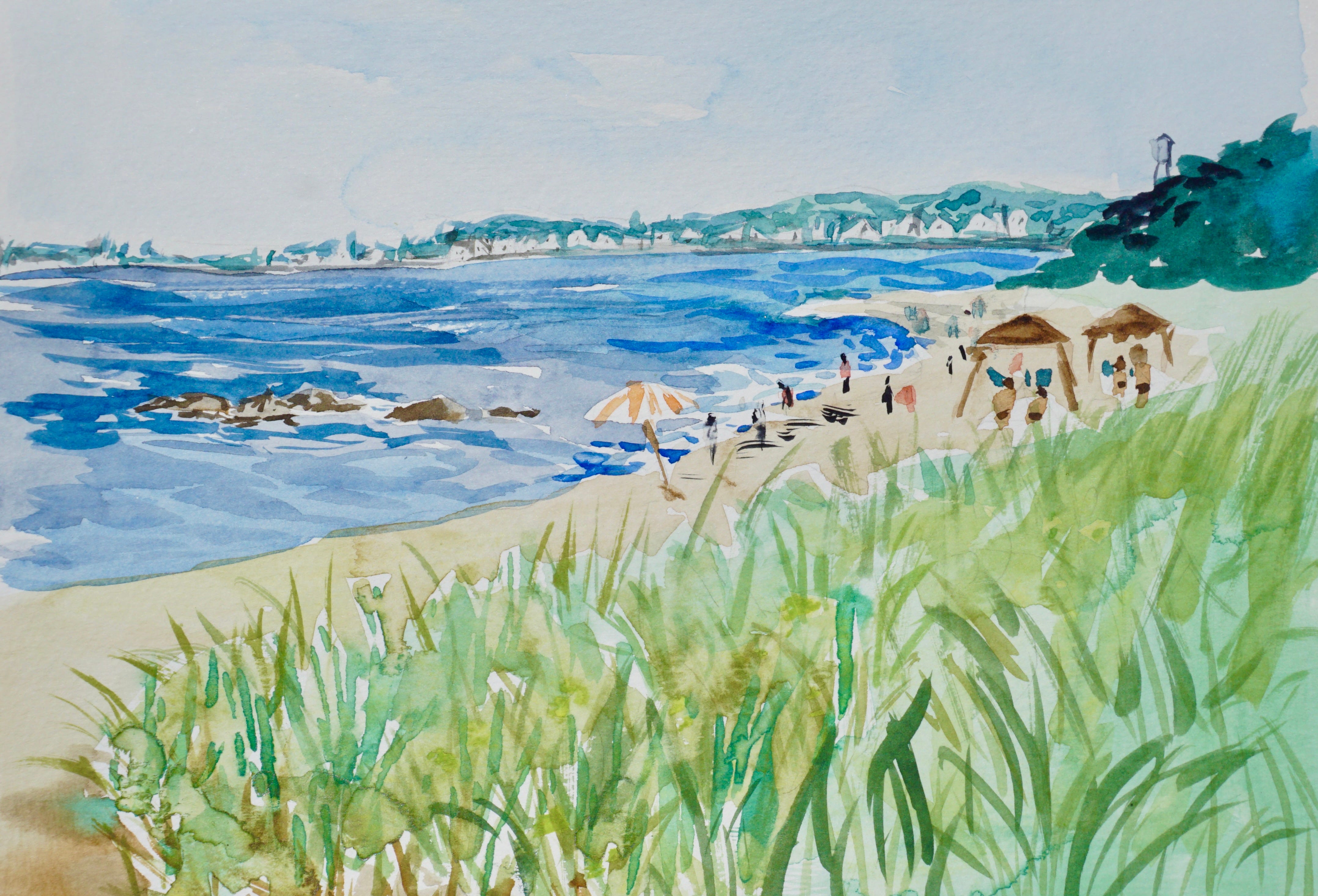

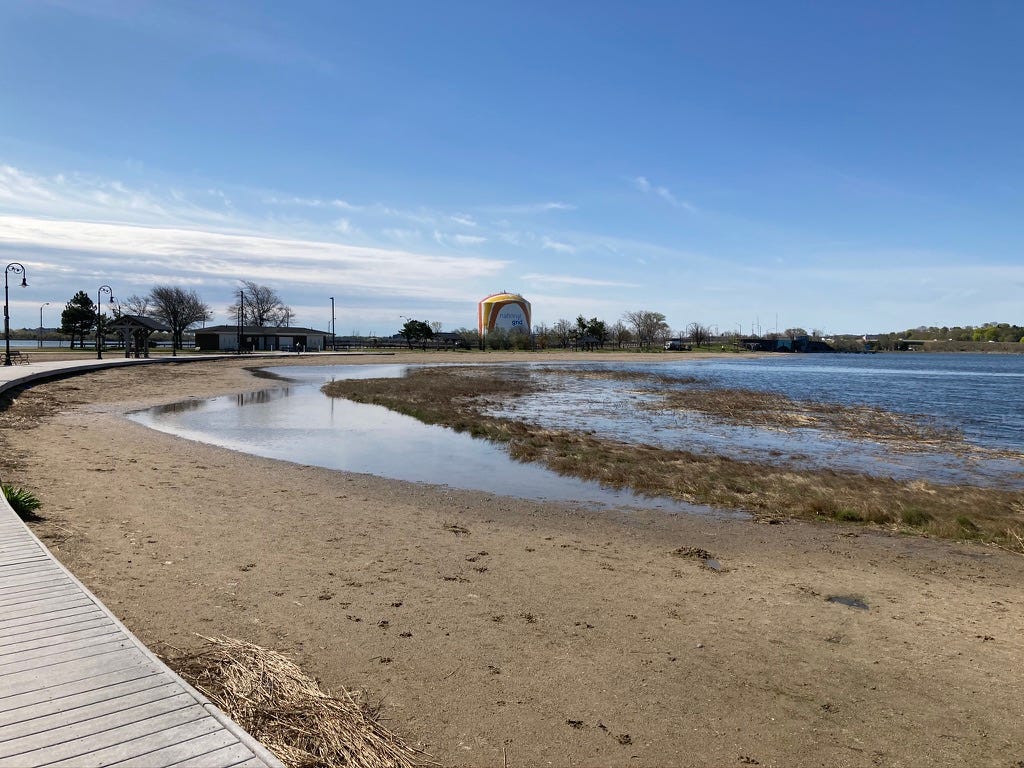
On an unseasonably hot day last weekend, my 7-year-old daughter persuaded me to take her to the beach. I opted for one of our closest, Carson Beach in South Boston. When we arrived in the late afternoon, I quickly saw that it was the wrong time to go: low tide. Boston has a nearly 10-foot tidal range, which translates into a more than 200-foot tidal plain on a shallow beach. She was determined to swim, and ran off optimistically with her goggles across the expanse of pebbly flats toward the shallow water’s edge.
I had hoped to read a book while she waded, but as she grew more and more distant, I sighed and decided I needed to follow her. I picked my way across the coarse rocky sand, avoiding broken clam shells and dead sea critters, out into the long plain of dark clay-like mud. My feet sank lower and lower through the squishy softness, sliding over hard lumps I knew were snails. Finally, I stopped when I was close enough to where she was splashing, plummeting below my ankles in ooze.
Another brave person crossed the mud near me, and we turned to chuckle to each other. With a confused look he asked me in a French accent if I knew why it was so muddy. “It’s just like this here,” I said with a shrug, because it was the simplest answer.
The longer explanation for why Carson Beach looks like a perfectly-beachy beach at high tide and an oozy mudflat at low tide is that the sand didn’t come from the ocean; it’s an artificial beach. Boston Harbor has naturally-occurring beaches, but some of the beaches in the urban core are really mudflats and marshes “enhanced” with sand, part of a 20th-century effort to bring waterfront recreation to a crowded city.
Nineteenth century maps depict this area as an inlet of marsh and mudflats surrounded by some industrial buildings. It was filled to create a wide waterfront road (originally cast as part of Frederick Law Olmsted’s Emerald Necklace, a series of connected parks and parkways in the city). Flats behind the road were filled with a combination of trash, dirt, and dredged clay to create a park, and a section of flats in front of it was topped with sand for a public beach.
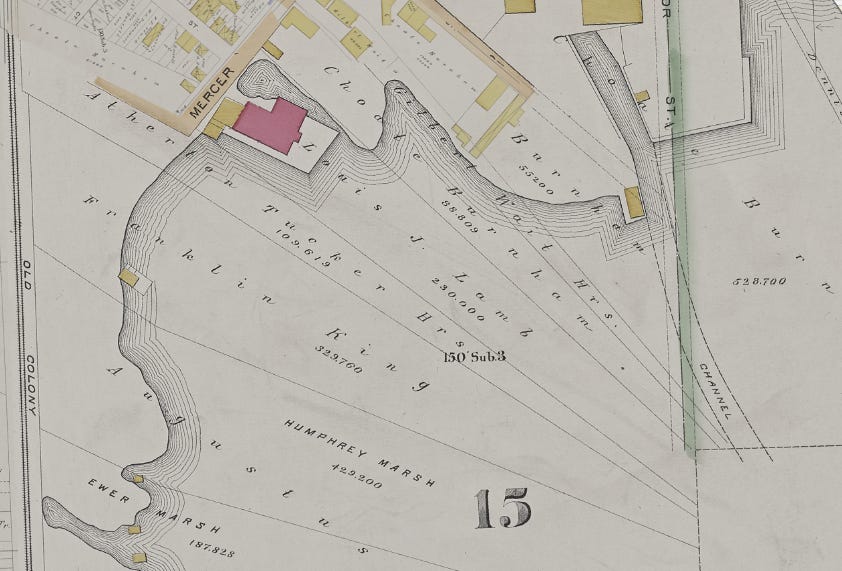
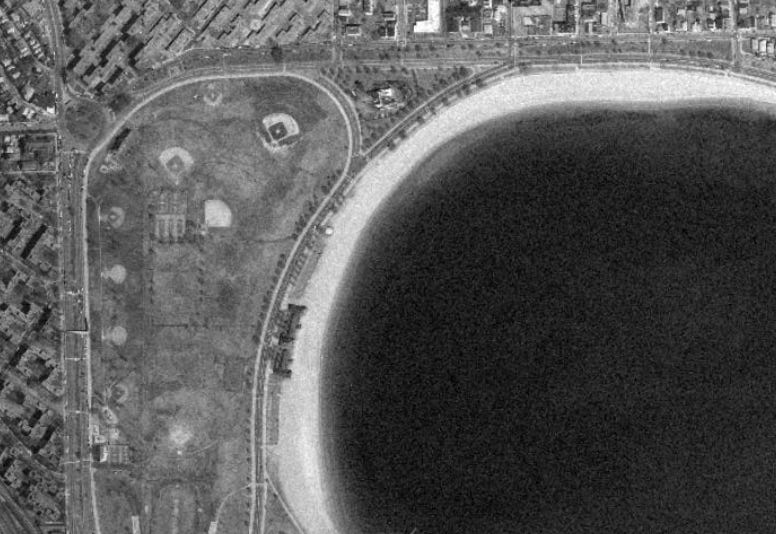
Later, I asked my daughter “What is a beach?”, expecting her to talk about sand and shells and swimming, but she quickly answered: “A landform caused by erosion.” (She’s a sponge for scientific information.) So, does dumping a bunch of sand on a mudflat make a beach? Maybe not, by some definitions.
Our closest beach, the optimistically named Malibu Beach in Dorchester, is another artificial beach created in an inlet sandwiched between a highway and a major road, with a view of our local landmark: a massive liquid natural gas tank. The sediment beyond the beach is so viscous that my husband and I once watched a person become stuck in it (from a distance, the inky-black figure seemed to be performing an interpretive dance, until we realized she was desperately trying to get out). Thankfully, a bevy of firefighters arrived and eventually freed her, only after two of them also got stuck.
So, ok. Our beach is not like the other Malibu.
I sometimes have my undergraduate students visit the urban beaches of Boston; to some who are used to destination-vacation beaches, the experience is disconcerting. But these beaches bring a connection to the water that is intrinsic to day-to-day life in these neighborhoods. I’m grateful that we can walk to our own little patch of sand by the ocean.
And, after all, many “real” beaches today depend a great deal on artificial intervention.
If you’re looking for a beach read, I recommend The Last Beach by geologists Orrin Pilkey and Andrew Cooper, an impassioned and provocative read on the science and management of beaches that will help you understand the predicament beaches are in.
Is your idea of a beach a specific place on a map with a parking lot and a clam shack? Then Pilkey and Cooper’s idea of a beach is not your beach.
Let’s call the first idea the human beach. When a storm comes and the sand washes away, the human beach seems to be disappearing. By their definition, however, a natural beach is a broader system, and it persists in a dynamic environment by changing. Beaches don’t disappear in storms, they write, they just “change their shape and their location, moving sand around to maximize the absorption of wave energy, then recover in the days, months or even years to follow.” Sea level rise and storms are not really threats to beaches: the beach will still exist, though in a slightly different form or location.
The real problems from the beach’s perspective are a lack of space to move because of development, and a lack of sand. Sand is the system’s food, and it must come from somewhere. As my daughter noted, beaches depend on erosion. Sometimes the source of eroded material is upland, such as rivers that wash sediment downstream. Or offshore, where small bits of shells wash up from nearby coral reefs. In New England, beach sand often comes from erosion of cliffs and bluffs. In all of these cases, human activity can inadvertently starve beaches. Dammed rivers stop bringing sediment. Jetties and other infrastructure keep offshore sediments from reaching the beach. Marine ecosystems diminish, leaving fewer shells to break down. And lots and lots of walls and stabilizers built to “protect” cliffs from erosion keep them from feeding the beach.
The Last Beach reads as a tragedy (or tragicomedy at times) recounting how these two ideas—the beach system and the human beach—are incompatible: “Two worlds are colliding at the shoreline—the beautiful, flexible, and infinitely adaptable world that is a beach, and the static, inflexible, urban beachfront world.” People often cause unintended problems when they want to be closer to nature; beachfront property, when shored up and protected, destroys the very thing that made it valuable.
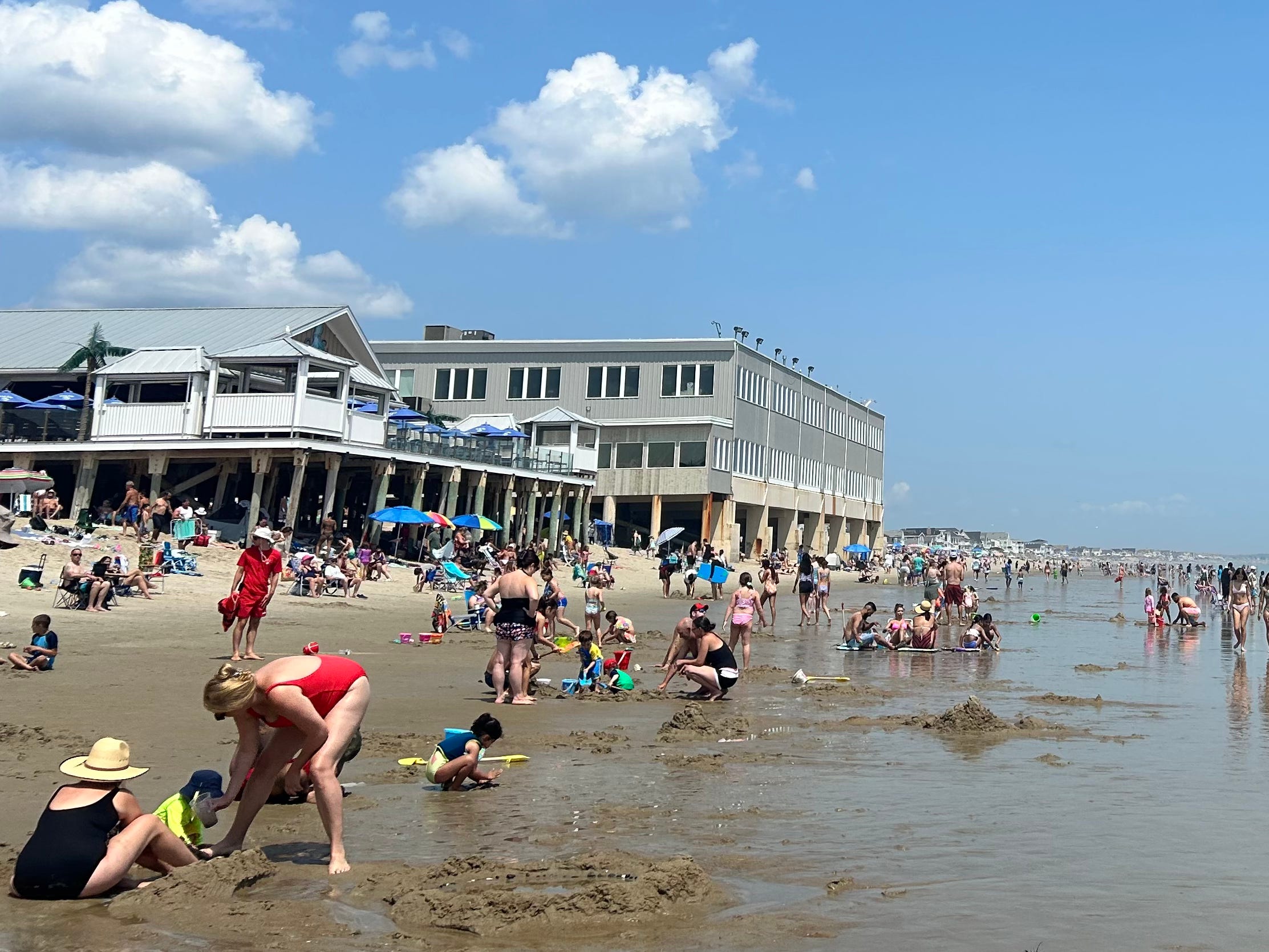
A tremendous amount of money and resources is put into trying to resolve this tension. It often involves spending millions of dollars to truck sand mined or dredged from somewhere else to the place on the map with the parking lot and the clam shack, to make it look like the beach still lives there. Yet the culprits (jetties, walls, buildings, roads) are left in place.
This practice is optimistically called “beach nourishment” and is often described as a nature-based solution and an environmentally-friendly alternative to seawalls. Pilkey and Cooper rail against the practice (and against coastal engineers generally). They believe it promotes urban development of beaches by sustaining the illusion that a beach can be held in place. Many of the coastal management professionals I’ve spoken with are dealing with a reality of an altered shoreline and they’re trying to find a compromise that will feed the beach, keep property owners happy, and avoid putting in more concrete walls.
But back to my urban beach. At Carson Beach, the water is calm, and there is little wave energy in this quiet corner of Boston Harbor because it is sheltered by islands. The original sand was replenished at some point, but it pretty much sits here. The biggest aspect of maintenance is raking and removing debris and trash from the heavily used sand to keep it clean. In that sense, even though Carson Beach is blatantly artificial, it’s arguably less intensively managed than some natural beaches in the state undergoing expensive beach nourishment.
So here’s another question: Does an artificial beach like this deserve protection? The piping plovers who sometimes nest here might say yes. This question came up back in the 1990s, when Boston was in the process of revitalizing its beaches as part of an ultimately successful Harbor cleanup project. A renovated bathhouse at Carson Beach was proposed on the site of the old one on the sand. But by then, environmental regulations prevented building on top of coastal dunes. Was it okay to build on artificially-made dunes? Apparently so, as the old bath house received yet another renovation last year. A similar debate took place at Malibu Beach, where the beach was restored at the expense of salt marsh grass that really wants to grow there. In that case, the beach won, but every blade of grass torn up was replanted along a nearby marsh on the Neponset River.
Managing coastal resources requires thinking through puzzles like this and often involves contradictory decisions to balance values and needs. There are rarely easy solutions. But a good goal for stewarding these spaces in the future is for us to strive to be more flexible. Ultimately, a beach is a process. It is not a snapshot locked in time. A beach is a landform made from loss, and we have to be willing to lose something to preserve it.
What is a beach? A beach is where I went to hang out with friends all summer, every summer until I turned 16 and was expected to get a summer job, where I learned strength to swim in the ocean far away from the crowds, where I wrote poems to Norman the Lifeguard. A beach is happiness.