


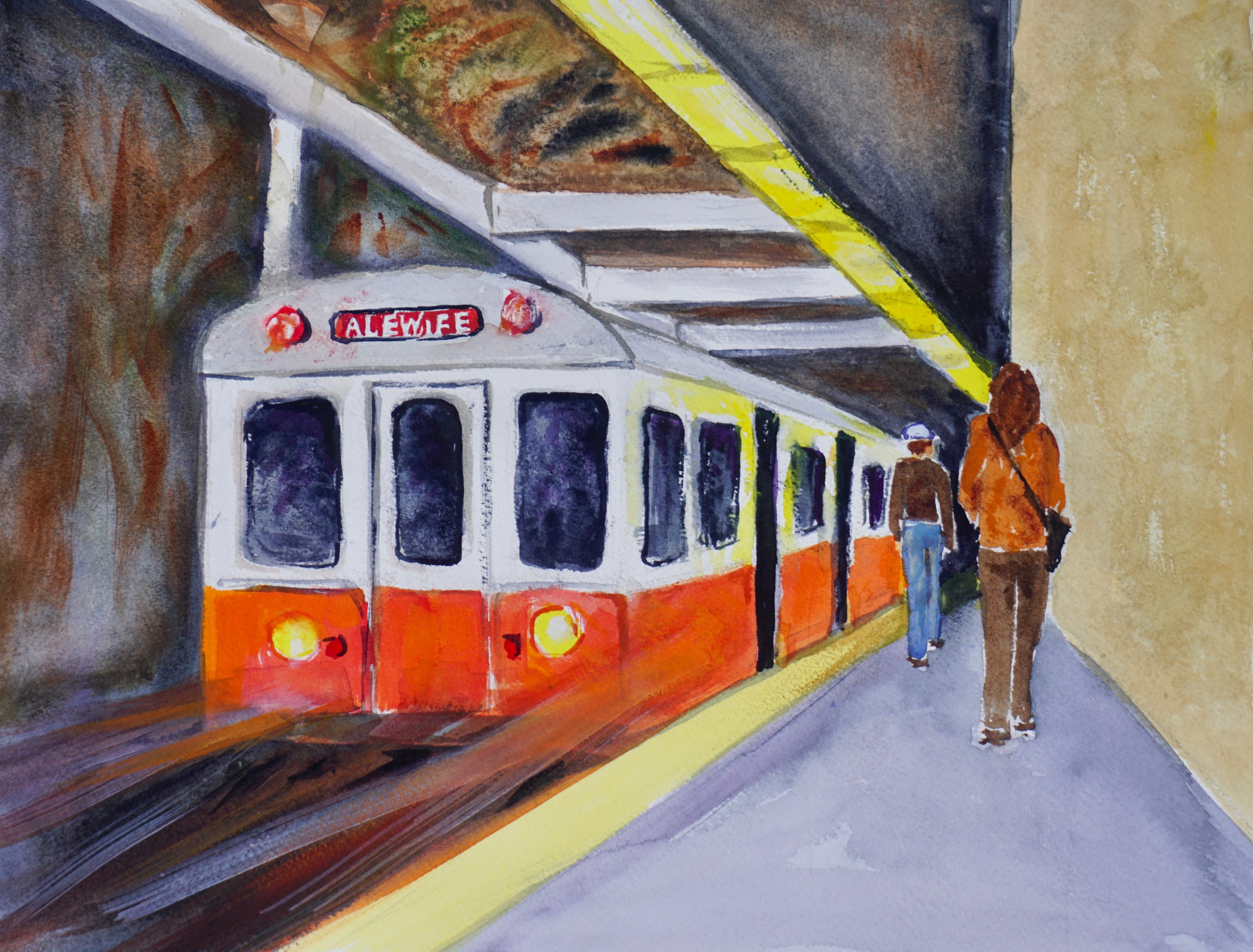
As I mentioned in my last post, I recently started a full-time position at the Harvard Graduate School of Design. I’m lucky to have a simple commute on the Red Line (the T, Boston’s subway for those out of town). I avoid driving through the city’s bitter traffic. My commute is not overly long, but long enough to listen to an audiobook or have a few minutes to scribble in my notebook while everyone around me swan-necks their phones.
Times being what they are, it’s a hybrid position, so I generally come into the office only three days a week. And this week I have the luxury of largely staying home as many fellow Redliners trudge across town in shuttle buses during a 10-day shutdown of the line.
I’ve found it oddly exciting to be a regular commuter for the first time in while. After working as a freelancer, graduate student, and professor, it’s rare for me to have an office job with regular 9-to-5 hours. I like toting my backpack and lunch bag to the train station in the mornings. I’ve begun to see the same people step on the train with me and leave the station at the end of the day. It reminds me that I’m entering a collective activity, a stream of movement that forms the backbeat of urban life.
In his classic 1949 meditation on Manhattan, Here Is New York, E.B. White writes that commuters “give the city its tidal restlessness” as they pour in each morning “out of the mouths of tubes and tunnels” and return the same way each evening. I love this tidal image, because it captures a quality of the daily commute that speaks to a larger role in urban development. While written about New York, it also describes how I see commuting shaping Boston’s geography over time.
Boston began as a seafaring town, and the city radiates like a hub around its historic port, with Boston Harbor forming the ocean side. In its early days, working where you lived was the norm. But just as Boston Harbor and its many small islands have been shaped by the force of tides pouring in and out each day, the tidal action of commutes taking place over years have influenced the city. While enabled by increasingly sophisticated transportation technologies, the gravitational force of commuting is the economic power of the city itself working against a desire (or need) to live farther away from that economic center and its physical environment.
The story of Boston’s growth is described in detail in The Hub’s Metropolis by James C. O’Connell. The city’s first commutes were seasonal, as wealthier residents of the city sequestered themselves in summer homes a few miles away from downtown in areas that became Boston’s outer neighborhoods and suburbs: Jamaica Plain, Roxbury, Brookline, Chestnut Hill, Milton. Transportation innovations made longer daily commutes possible. Suburbs formed around railroad stations near Boston. Horse-drawn omnibuses and later privately-run electric streetcar lines began to fill the streets, letting people cross a greater territory each day. This led to a wave of population expansion into what historian Sam Bass Warner Jr. called streetcar suburbs. Outer neighborhoods and towns densified with Boston’s signature housing form, triple-deckers (or “three-deckers,” depending on how Boston you are), with three spacious stacked units and shared yards.
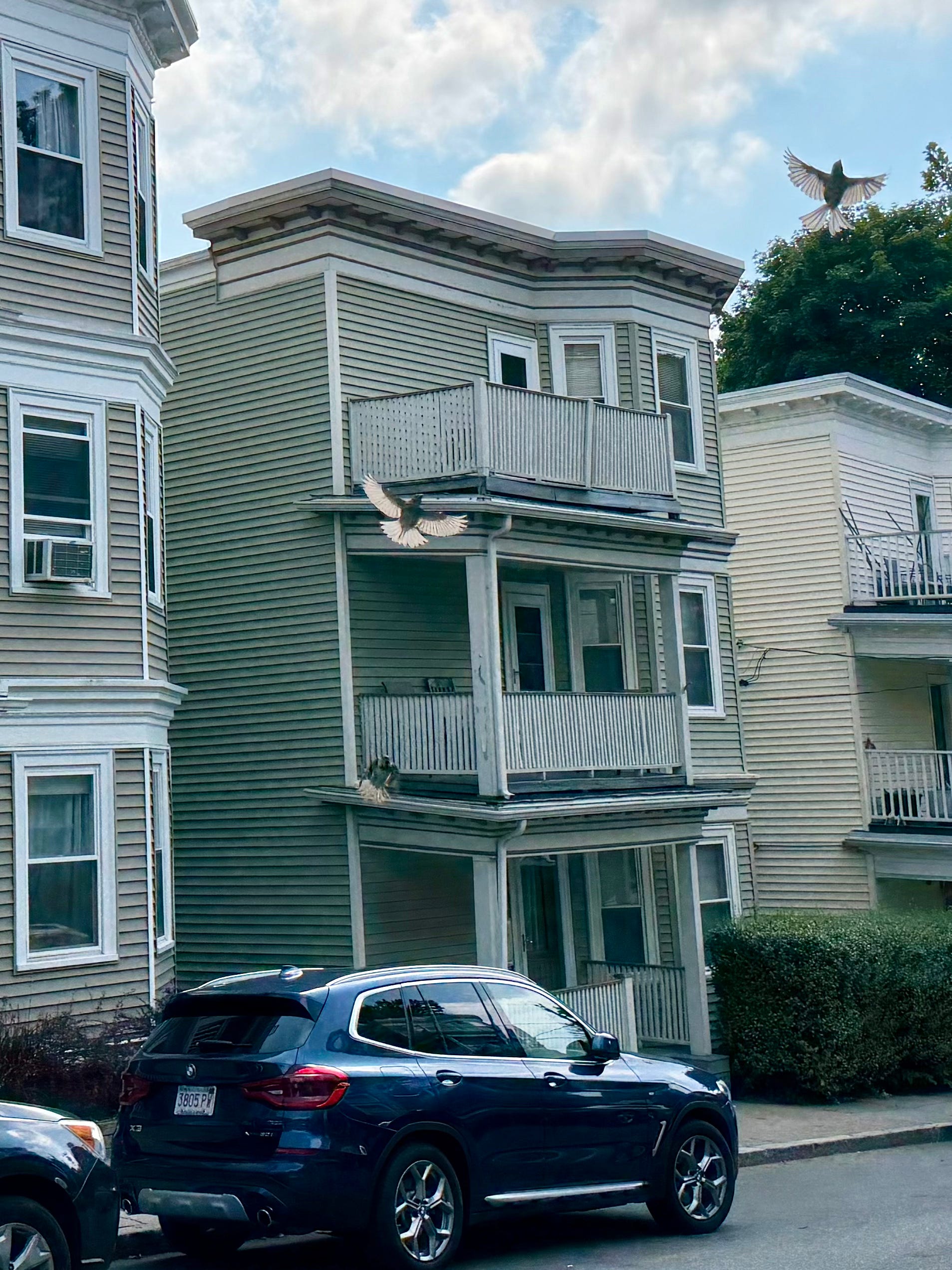
By the end of the 19th century, a private company was constructing the country’s first subway (just beating New York). By then, Boston had become a metropolis, and the city engaged in regional planning to manage growth, including creating a metropolitan park system and parkways that spurred new neighborhoods at commuting distance. The spread of the automobile then led to a new kind of suburbanization in the 20th century, creating the single-family enclaves we typically associate with the suburban typology.
Tidal cycles are not just daily, or even monthly; some stretch over years. Similarly, larger trends shape the daily commute. With new highways, a postwar housing boom, and the popularity of a suburban lifestyle, more people traveled miles in and out of the city each day, using the city a place to work or shop rather than a place to live. Boston entered a decades-long drain of population as its suburbs and exurbs swelled. The exurban spread was, of course, reinforced by exclusionary zoning meant to preserve the “character” of outer communities.
This long-term movement has gradually reversed as urban investment and lifestyle changes have brought the city’s population up again. But commuting didn’t disappear. As New England’s largest city, Boston still has a pull on commuter traffic; it sources about 75 percent of its jobs to workers who live outside the city.
The history of commuting is reflected in the physical geography of the city. A pattern of development and suburban flight leaves the city with a highly uneven landscape of density and green space. The map below highlights how the heat index of Boston’s neighborhoods is largely determined by density, with he inner core of Boston and its commercial centers along transit lines experiencing greater summertime heat than the early summer enclaves and streetcar suburbs, which are more likely to have tree-lined streets and yards. Residential neighborhoods built for an urban workforce, like East Boston and the North End, have less than 10% tree cover, while neighborhoods built largely around commuters such as Jamaica Plain have over 40%.
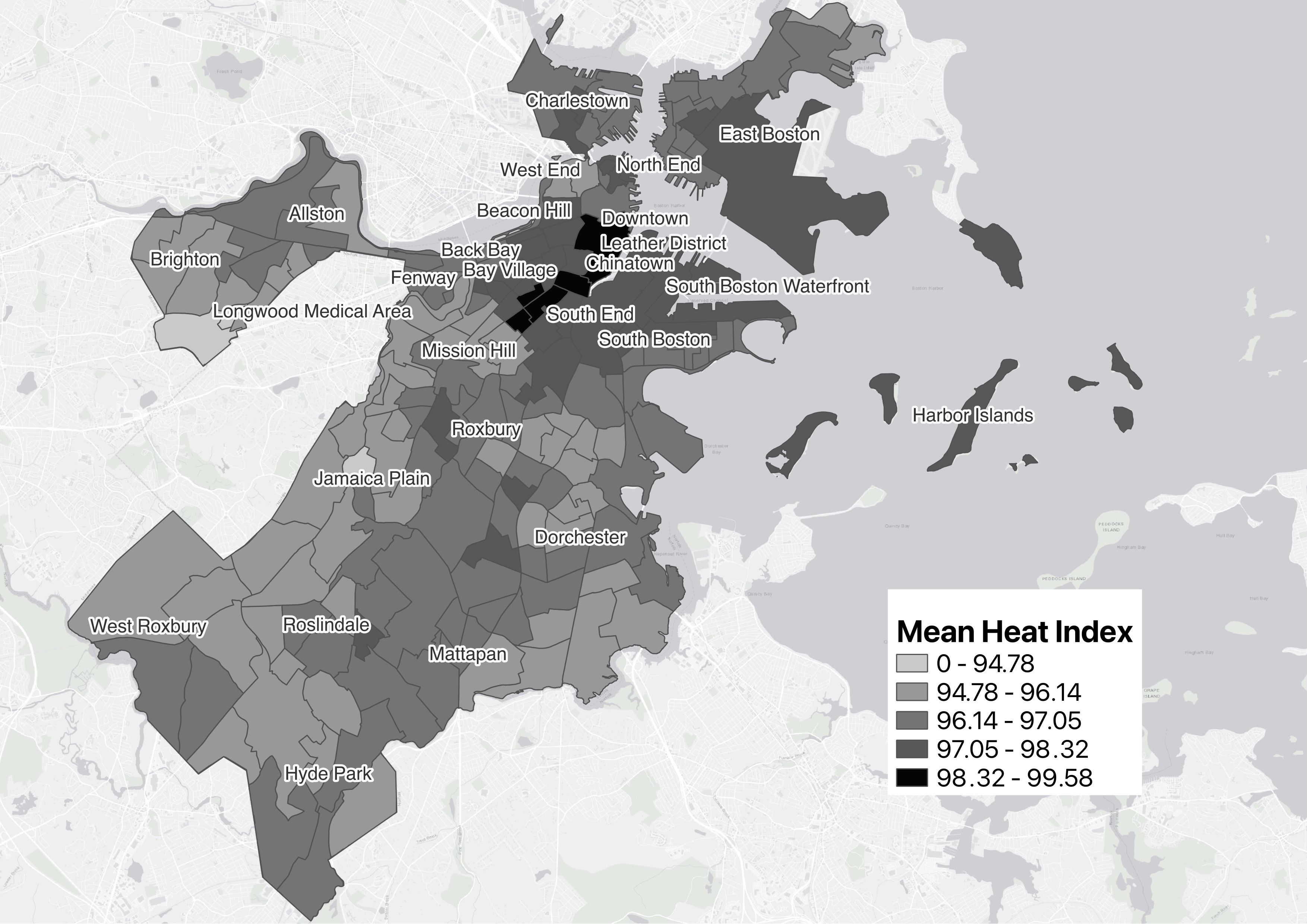
As I describe in my recent book on climate change in Boston, this pattern shapes the challenges and opportunities the city faces in adapting to a changing climate. This is why equity becomes such an important issue in adapting to climate impacts.
My current commute does not exactly match the historic in-and-out tide I’ve described, since I’m traveling from the neighborhood of Dorchester through Downtown Boston and out to the adjacent city of Cambridge. Because the entire metro area has smaller cities with strong economic centers (Cambridge houses the educational juggernaut of Harvard and MIT, plus one of the world’s most concentrated tech hubs), many commuters are like me: swishing back and forth in a metropolitan bathtub rather than flowing in and out between suburbs and downtown.
Commuting continues to reshape the city as it evolves. The Covid-19 pandemic was a watershed for many cities, including Boston. The percentage of Bostonians who worked exclusively at home quadrupled between 2019 and 2023 to 18 percent. Many workers, like me, have hybrid jobs. The entire city has been plagued by high vacancy rates in its office buildings since the pandemic, and like many cities, Boston is experimenting with refashioning office buildings into housing.
While technically challenging, housing conversions would allow more people to live right in the city. It would also help counteract the other major force affecting commutes: affordability.
As cities like Boston become increasingly unaffordable, more of its workers are living farther away. And hybrid work allows more people to accept a longer commute if they’re not traveling every day. Hence the rise of “supercommuters” who travel 90 minutes or more each way to and from work. That adds up to a great deal of living time.
So commuting hasn’t disappeared, but its patterns are shifting. Part of why Boston’s commuting history interests me is that I grew up in a very different kind of city (Albuquerque), which came of age alongside the automobile and has a very different development pattern: sprawling street grids around diffuse commerce and neighborhoods rather than a dense central city radiating out. The idea of a central downtown as an organizing principle has fascinated me. While I’m enjoying flowing with this tide, I’m also aware that many commutes are less pleasant than mine. They suck time away from families and communities, and they sap mental health.
Every city is shaped by the daily commute. How does commuting impact you and the place you live?
I live in a small town that borders Boston. And although my job is technically available anywhere I am called to urban public education. My commute is glorious in that I am able to get to and from my job by bicycle year-round, aided by public bike paths for which I am so grateful! So much so that I do not plan to leave my job until retirement, even though I have considered it some years (sticking it out has made me a better employee and person) and I won’t move houses even though our starter home has felt tight with 3 teenagers. I love my commute so much. Biking gives me not only absence from traffic and parking but also physical fitness and mental well-being.
Very interesting Courtney. I remember the day we drove to pick up Mateo to go to Acoma, and you explained the naming of the streets of Albuquerque! I like grids. Easy to navigate. Manhattan was a cinch. But the Raleigh area doesn’t have grids: seemingly parallel lines intersect ( Riemannian geometry?), circular parkways intersect the same street in two places, street names change as you cross a major thoroughfare, and roads are not continuous- stopping suddenly only to reappear at an unexpected place! My father taught us to navigate with the sun but its not easy if the roads are not in a grid.
Im glad you have an easier commute to Harvard rather than Smith!!