


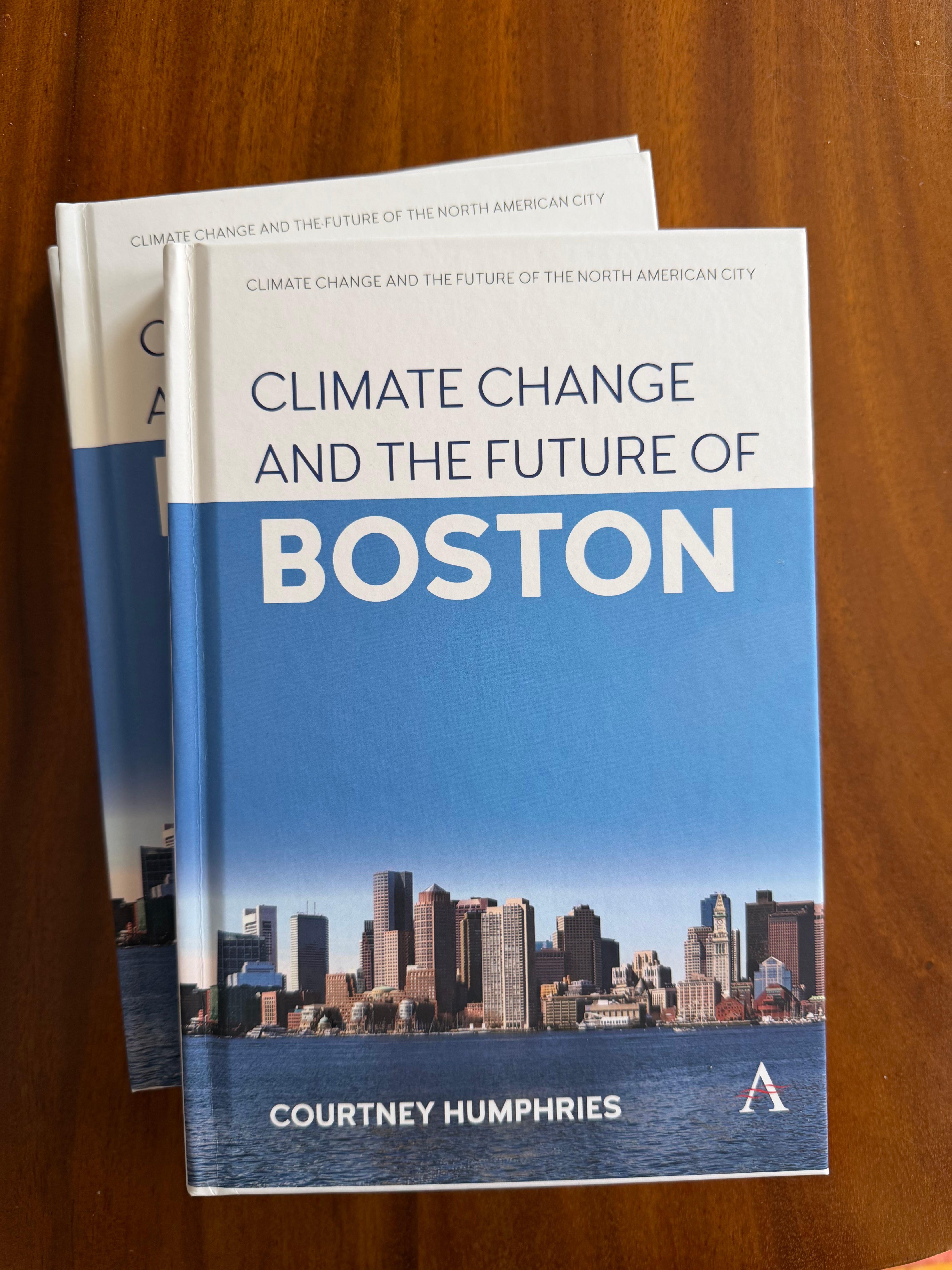
This week I’m departing a bit from my usual essay on urban environments to announce some news: the publication of my book, Climate Change and the Future of Boston, with Anthem Press. It gives a brief but deep dive into the city’s risks, challenges, and opportunities in a changing climate.
The idea for the book grew out of work by the Urban Climate Change Research Network based at Columbia University, which assesses how urban areas are responding to climate change and collects case studies of specific issues in different cities. This book expands that approach to look at the dynamics of climate action and governance in a specific city, both to understand those dynamics better and hopefully to allow for comparisons across cities.
My approach was also informed by my own PhD research, which examined how the historical management of Boston’s shoreline shapes current planning for future sea level rise. In the book, I look at some of the ways that Boston is influenced by its history, both in terms of the climate risks it faces and its ability to mitigate and adapt to climate change.
If you’re interested in learning more, here’s a recent interview for the New Books Network podcast. If you’re local to Boston or connected to a university anywhere, consider asking your library to buy a copy of the book!
I’m aware that this book comes at a disheartening time if you live in the United States and care about climate change. The news over this past year has been devastating, including the country’s withdrawal from the international Paris Agreement, federal funding cuts for climate-related projects, and the U.S. EPA’s repeal of its “endangerment finding” recognizing that greenhouse gas pollution threatens human health.
But from my view as someone focused largely on climate action at the local level, there is much to be excited about. Despite federal policy, many cities, suburbs, and communities across the country are moving forward to both prepare for climate change and to reduce their climate impacts. I describe how Boston’s ecosystem of local government, nonprofits, academic research, citizen action, business groups, and philanthropists are helping to push innovation forward despite challenges.
This week, I visited Miami, Florida during Miami Climate Week, where I was an attendee, moderator, and panelist at the Resilience 365 Conference. Boston and Miami are vastly different cities in terms of geography, ecology, culture, politics, economics, and development history. But I heard many of the same goals and challenges that I’ve heard in Boston.
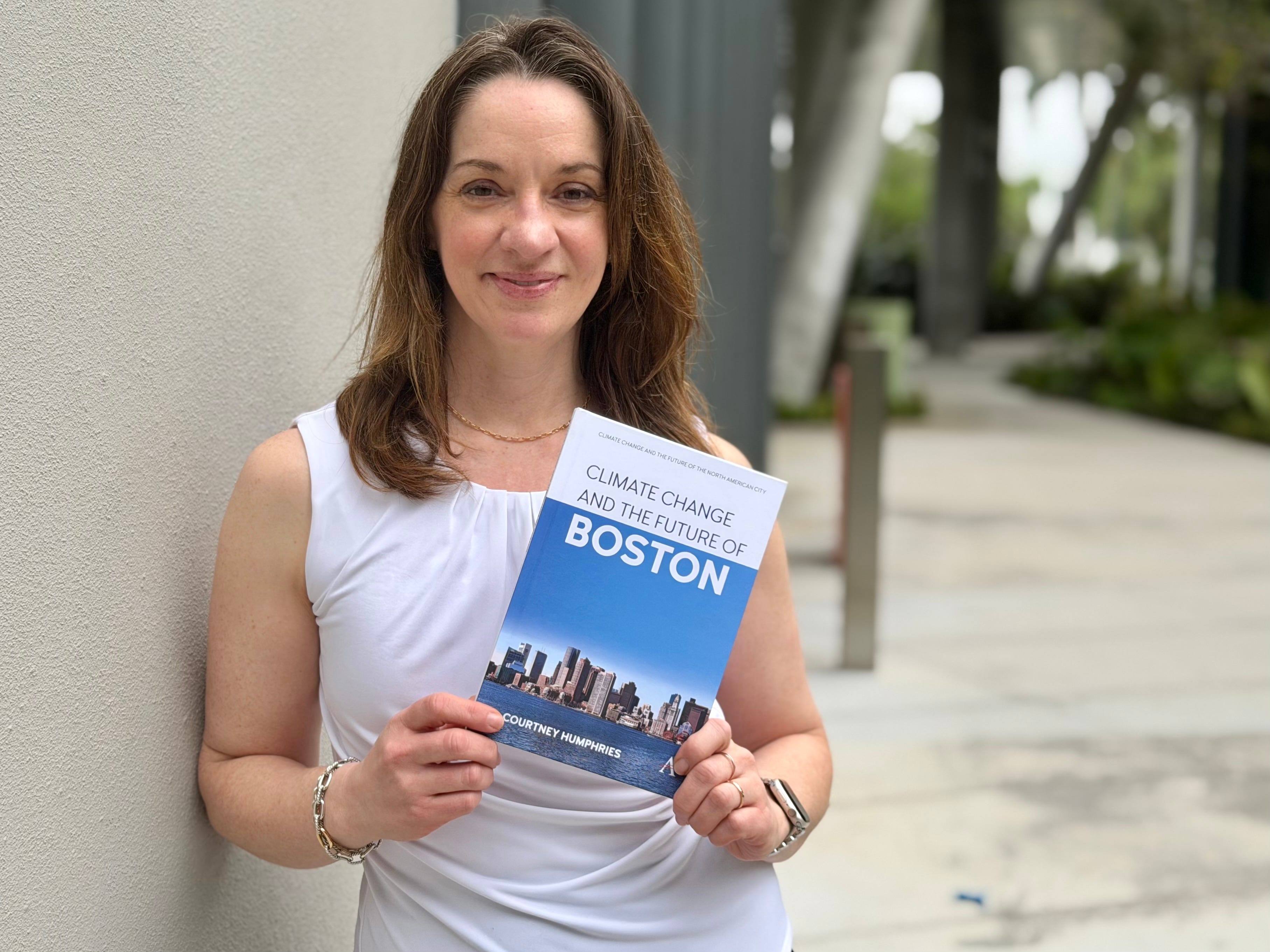
Folks in Miami are acutely aware that they are considered ground zero for climate change in the United States. Miami’s shoreline is held up as an iconic example of urban hubris in the face of risk (as one person told me, it’s always the first slide in every PowerPoint presentation on urban climate change). It’s among the most vulnerable cities to the impacts of sea level rise. Like Boston, one of the most daunting challenges right now is financing new infrastructure without federal support and local willingness to pay for improvements. And advocates are working within a political situation in which the local government, incredibly, can no longer use words like “climate change” or “net zero“ despite the fact that 90% of Floridians believe climate change is happening, higher than the national average.
But local action in Miami is strong. I was able to meet and listen to policymakers, nonprofit workers, academics, and consultants working in Miami and other areas of South Florida to build resilient and efficient housing, create living shorelines in flood-vulnerable areas, seek creative ways to finance resilient infrastructure, and work with communities to restore a better relationship to water. They are doing innovative work to deal with intersecting water challenges, which include coastal flooding, stormwater and river flooding, groundwater and drinking water pollution, and drought. A few years ago, residents, businesses, and environmental groups successfully fought off a U.S. Army Corps plan to protect areas of the city along Biscayne Bay with seawalls, forcing the agency to instead investigate a nature-based approach.
It’s clear that scrubbing a few words from government documents and grant proposals won’t stop this momentum.
I tend to view urban climate action through a broader historical lens of urban development. Cities in the United States and other parts of the Global North that underwent industrialization in the 19th century faced pollution and public health problems from rapid growth. The response was what historian Martin Melosi called the “Sanitary City”— an infrastructural revolution that led to centralized systems to manage water, sewage, and waste. Sanitary cities evolved to include zoning and environmental regulation to redirect and control pollution. Sanitary cities are successful but also lock in systems that make change difficult.
We are, arguably, in a decades-long transition to new urban forms, guided by a few key visions. The primary vision is the Sustainable City that is less wasteful, more efficient, and runs on renewable energy rather than fossil fuels. Another related vision is the Resilient City that will allow residents to continue to thrive even as our planet makes an unprecedented leap out of the mild temperatures and predictable weather patterns of the Holocene. The Just City strives to make this transition happen in an equitable way. We might also add the Biophilic City that aims to create more nonhuman nature and biodiversity in the built environment.
I see these goals as more than fantasies because I meet so many people working towards them. But I admit that, outside of this world, it can be hard to see evidence that cities are changing for the better. Yes, we have more bike lanes and tree plantings and LEED-certified buildings, but we also have the global challenges of ever-rising greenhouse gas emissions, consumption, waste, income inequality, extreme weather events, and accumulating risk.
Even at the local level, sustainability and resilience projects often fail to live up to lofty expectations. They sometimes benefit wealthy landowners more than other community members, contribute to gentrification and displacement, or simply fail to have an environmental impact beyond giving a company or city government a green-washed marketing tool. That’s why I feel it’s essential to gather data about this work and to support research and writing that takes a critical perspective on urban sustainability and resilience policy and projects (I have contributed to this literature as a journalist and researcher).
Just because something is problematic doesn’t mean it’s not worth doing. It would be hard to imagine an effort as complex as reorganizing a city’s relationship to energy, water, waste, and nonhuman nature without major obstacles and tradeoffs, particularly when this work takes place in an economic and political context favoring money and power. So while I view these efforts through a critical lens, I think their goals are absolutely necessary. I don’t believe cities in the future will match the ideals I’ve described above, but many aspects of urban infrastructure are changing for the better. I’m heartened by the collective energy from people on all sides of the political spectrum to make that happen.
Thank you for all of your hard work. Regarding Miami’s vulnerability, all that you say it’s clearly evident from the back porch of The Rusty Pelican in Key Biscayne.
Congratulations Courtney! Im glad you are on the case of this uphill battle.